Hours
Mon–Fri, 7:30 AM–5:00 PM; Sat, 9:00 AM–1:00 PM
9670 Monterey Rd, Morgan Hill, CA 95037
Mountain View Roofing Services
Mountain View roofing work is not a generic Bay Area city page. Qualifying existing single-family and duplex reroofs may use the city's same-day path, while added skylights, structural changes, heavier material changes, and addition or remodel work can change the permit route.
This guide connects roof replacement and re-roofing, leak diagnostics, drainage, skylights, commercial low-slope roofs, and maintenance planning to Mountain View's permit rules, inspection readiness, Climate Zone 4 cool-roof review, and Bay/Permanente Creek drainage exposure.
Mountain View publishes same-day reroof eligibility for existing single-family homes and duplexes when the work complies with the listed code, fire-rating, ventilation, and product-documentation requirements.
A reroof that adds skylights, changes framing, ties into a remodel or addition, or switches to a heavier material is no longer a simple same-day reroof assumption.
Mountain View is generally handled in a Climate Zone 4 context, but final energy compliance should be verified by address, roof slope, product rating, and actual replacement scope.
Bay and Permanente Creek flood exposure, low-lying Shoreline conditions, and city final-inspection overflow-drain items make gutters, roof drains, scuppers, and overflow paths more than generic add-ons.
Mountain View should not be written like a hillside fire-zone city. The stronger local story is permit specificity, drainage exposure, low-slope commercial roofs, and skylight/energy documentation.
The service list stays focused on roofing work. Permit filing, inspection coordination, and rooftop-equipment coordination are treated as supporting steps inside the reroof, commercial, skylight, inspection, and maintenance scope instead of standalone service lines.
Leak tracing at skylights, valleys, pipe penetrations, wall transitions, low-slope tie-ins, roof edges, and older repair areas.
Mountain View angle: Mountain View leaks often need a water-path diagnosis before anyone decides whether the answer is repair, localized flashing work, or a larger reroof.
See roof repair servicesProperly scoped reroofs with deck review, ventilation planning, flashing replacement, drainage checks, and cool-roof product documentation when the scope triggers it.
Mountain View angle: A qualifying existing single-family or duplex reroof may fit Mountain View's same-day path, but skylights, structural work, heavy material changes, and addition work need a different conversation.
Review roof replacement planningLow-slope roof repair, replacement planning, drain and overflow review, equipment curb detailing, penetration checks, and maintenance documentation.
Mountain View angle: North Bayshore and other office, retail, mixed-use, and multifamily roofs need low-slope drainage and rooftop-equipment planning that is not the same as a small shingle reroof.
Explore commercial roofing supportPhoto-documented roof evaluations covering roof surface, flashings, penetrations, skylights, drainage, ventilation, and available permit-history context where useful.
Mountain View angle: Mountain View permit history can be useful for recent work, but not every older record is online, so field inspection still carries the roof-condition story.
See roof inspection servicesRoof-edge runoff planning for gutters, downspouts, outlets, scuppers, roof drains, overflow drains, fascia protection, and discharge routing.
Mountain View angle: With Bay and Permanente Creek flood context plus final-inspection overflow-drain expectations, drainage deserves more weight here than on a cloned inland city page.
Review gutters and drainageSkylight leak diagnosis, repair, reflashing, same-opening replacement planning, curb review, sun tunnel integration, and roof-material-specific flashing work.
Mountain View angle: Adding skylights can remove a Mountain View reroof from the same-day path, and skylight flashing should be selected by roof type, slope, curb or deck mount, and product requirements.
See skylight and sun tunnel workSeasonal maintenance plans for drains, gutters, skylights, penetrations, low-slope membranes, commercial roof logs, and pre-rain readiness.
Mountain View angle: Mountain View maintenance is strongest when it catches drainage restrictions, skylight flashing fatigue, and low-slope ponding before a winter storm window.
Plan preventative maintenanceMountain View uses ePermitsMV for Building and Fire Protection permit submittals, and the city publishes a same-day reroof permit path for qualifying existing single-family homes and duplexes. The value of that path depends on describing the roof work honestly before tear-off.
A clean same-day candidate is not the same thing as every reroof. If the scope adds skylights, changes roof structure, changes to a heavier material, or adds a roof as part of a remodel or addition, the permit conversation should be reset before the job is priced as routine.
Mountain View's reroof guidance is strongest when it is treated as job-sequencing guidance, not just paperwork. Different roof materials have different initial checkpoints, and final inspection includes drainage, skylight, flue, equipment, nail, wood, and metal-detail closeout.
Mountain View's reroof guidance calls out early composition-roof items such as sheathing nailing, felt, valleys, flashing, courses started, and rake drip-edge placement before the job moves too far ahead.
The city separates initial inspection expectations by material type, so tile, shake, tar-and-gravel, and foam work should be staged around the correct roof-specific milestone instead of treated as the same inspection.
Final readiness includes completed work, cleaned overflow drains, secured skylights, extended and secured flues, secured roof equipment and piping, protected exposed nails, and painted exposed wood, roof jacks, metal flashing, or edging.
Mountain View generally schedules inspection requests submitted by 3 p.m. for the next business day and later requests for the second business day, with AM or PM windows rather than exact arrival times.
For current filings, Mountain View is in the 2025 code cycle for applications submitted on or after January 1, 2026. Mountain View is generally discussed in a Climate Zone 4 context, but the California Energy Commission warns that final climate-zone and compliance decisions should be checked by address and project scope.
For applications submitted on or after January 1, 2026, California's 2025 Building Standards and 2025 Energy Code are the current baseline for Mountain View roof conversations.
Residential roof replacement energy forms treat 50% or more of the roof being replaced as the practical trigger for applicable roofing and cool-roof requirements.
When the 2025 residential steep-slope cool-roof path applies in Climate Zone 4, the form identifies aged solar reflectance 0.20 and thermal emittance 0.75, or SRI 16, subject to exceptions and alternatives.
For low-slope residential work in the same climate-zone context, the form identifies aged solar reflectance 0.63 and thermal emittance 0.75, or SRI 75, again subject to exceptions and alternatives.
When cool-roof rules apply, product selection should include CRRC Product ID and rated reflectance/emittance documentation rather than a color guess or generic material claim.
Nonresidential roof-energy requirements can depend on conditioned space, insulation, roof area, replacement depth, and project scope, so commercial Mountain View roofs should not use one-size-fits-all cool-roof copy.
Product selection should be tied back to the actual roof assembly and documentation, including residential alteration forms, CRRC-rated product data, and project-specific nonresidential review where applicable.
Mountain View's practical roofing issues come from its building mix and roof details: single-family and duplex roofs that may fit the same-day path, multifamily and commercial roofs with low-slope drainage issues, and North Bayshore properties where roof drains, equipment curbs, penetrations, and maintenance records matter.
North Bayshore's office, retail, residential, community, and open-space planning context supports separate commercial roof content around membranes, drains, equipment curbs, penetrations, phased work, and maintenance documentation.
Mountain View includes R1 single-family areas along with R2 and R3 contexts, so the page should speak to shingle and tile houses, duplexes, multifamily roofs, and low-slope assemblies.
About 12% of Mountain View is in special flood hazard areas tied to tidal flooding from the Bay and Permanente Creek, which makes overflow paths and roof-edge runoff worth planning early.
Skylights, pipe penetrations, flues, roof equipment, and attic cross-ventilation all show up in Mountain View's reroof and final inspection guidance, so they belong in scope planning.
Mountain View's city code-adoption materials state the city is not in a designated wildland-urban interface area, so WUI language should not dominate this page.
The best material discussion starts with the roof type, slope, drainage path, permit route, skylight openings, and energy documentation instead of a generic list of products.
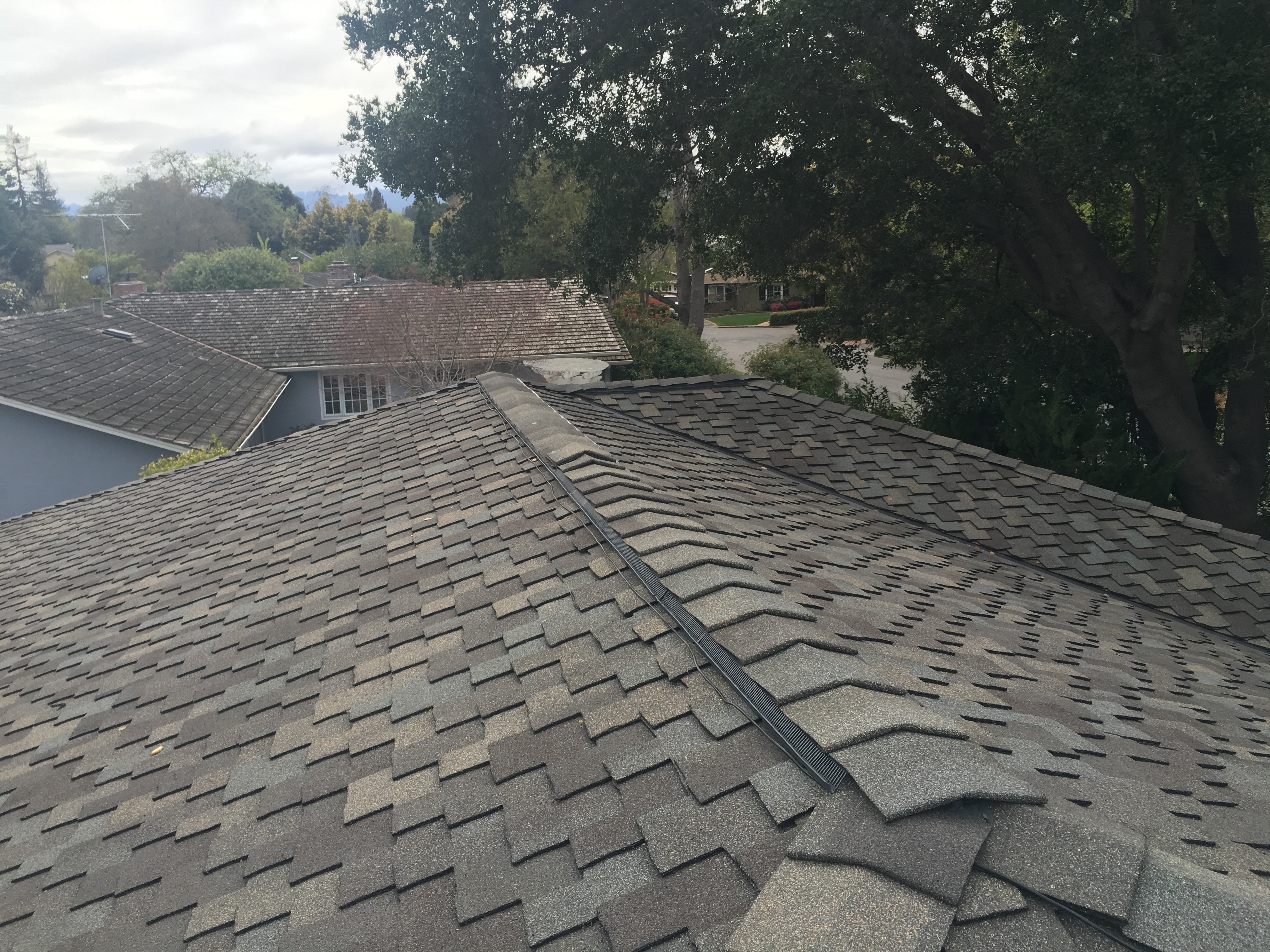
Composition roofs should be planned around deck condition, valley detailing, drip edge, penetrations, ventilation, and the product documentation needed for the selected assembly.
Tile roofs need underlayment, valley metal, flashing, broken or slipped tile review, and load awareness before material changes are priced as routine.
Low-slope residential, multifamily, and commercial roofs in Mountain View need attention to ponding water, drains, scuppers, overflow drains, seams, curbs, and reflective roof choices.
Metal roof planning should account for thermal movement, fasteners, seams, roof-material-specific flashing, penetrations, and rated product documentation.
Skylight diagnosis should separate unit failure, flashing failure, curb or underlayment failure, and surrounding roof failure before recommending caulk, reflashing, or replacement.
Drainage should be treated as a roof-system detail because water leaving the roof can damage fascia, siding, lower roofs, walkways, landscaping, and foundations.
Mountain View specifically lists added skylights as a same-day reroof disqualifier. That does not mean every skylight stain needs the same answer; it means the scope should separate repair, reflashing, same-opening replacement, and new openings before the reroof path is chosen.
Manufacturer guidance also matters. VELUX describes flashing systems as roof-type, slope, and mounting-dependent assemblies, so a caulk-only skylight repair should not be the default answer during a reroof.
The highest-value maintenance plan in Mountain View keeps drainage, skylights, low-slope roof areas, rooftop equipment, and permit records connected. It also avoids promising exact city inspection timing; Mountain View gives AM/PM windows, not guaranteed exact arrival times.
Clean gutters, outlets, roof drains, scuppers, and overflow drains before storm periods, especially under mature trees or on low-slope roofs.
Inspect skylight curbs, manufacturer flashing, roof-to-wall transitions, flues, pipe penetrations, and rooftop equipment before a small stain becomes a larger leak.
For office, retail, multifamily, and North Bayshore-style low-slope roofs, maintenance records help track ponding, drains, membrane seams, roof traffic, and equipment service impacts.
Mountain View permit history from 2000 forward may be viewable online, but older or missing records can require Permit Center research, so reports should pair available records with field findings.
Permit requirements, inspection scheduling, code cycles, cool-roof triggers, flood context, and product documentation can change. Gray-area scope should be confirmed against current official sources before filing or material ordering.
Use this page as the Mountain View-specific guide, then move into the relevant service detail when the scope is clearer: roof inspections, repairs, replacement, gutters and drainage, skylights, and maintenance planning.
For broader coverage, visit the service areas page or the general roofing FAQ.
Mountain View publishes a same-day reroof permit path for qualifying existing single-family homes and duplexes, but scope still matters. Repairs, partial work, full reroofs, skylights, structural changes, and material changes should be evaluated separately.
The city lists several disqualifiers, including changing to a new or different roof material over 7.5 lb/sf, adding a new roof as part of a remodel or addition, modifying roof framing or structure, and adding skylights.
Yes. Adding skylights is specifically listed as a condition that removes a reroof from the same-day reroof path, and skylight scope can also raise California energy or fenestration documentation questions.
Mountain View's composition reroof guidance includes items such as sheathing nailing, felt, valleys, flashing, courses started, and rake drip-edge placement at the initial inspection stage.
Final readiness includes completed work, cleaned overflow drains, secured skylights, extended and secured flues, secured roof equipment and piping, protected exposed nails, and painted exposed wood, roof jacks, metal flashing, or edging.
For residential projects, California energy compliance can apply when 50% or more of the roof is replaced. Mountain View is generally discussed in a Climate Zone 4 context, but the final climate zone and compliance path should be verified by address and scope.
For Climate Zone 4 steep-slope residential reroof work subject to the 2025 requirements, the compliance form identifies aged solar reflectance 0.20 and thermal emittance 0.75, or SRI 16, with exceptions and alternatives available.
For Climate Zone 4 low-slope residential roof work subject to the 2025 requirements, the form identifies aged solar reflectance 0.63 and thermal emittance 0.75, or SRI 75, subject to exceptions and alternatives.
Mountain View's code-adoption materials state that the city is not located within a designated wildland-urban interface area, so WUI messaging should not dominate a Mountain View roofing page.
Mountain View identifies special flood hazard areas tied to tidal flooding from the Bay and Permanente Creek, and final reroof inspection guidance includes cleaned overflow drains. That makes gutters, downspouts, roof drains, scuppers, and overflow paths locally important.
Permit history from 2000 to current can be viewed online in many cases, but Mountain View notes that not all records are online and older records may require Permit Center research. A useful report combines available records with field inspection.
The strongest local topics are skylight flashing leaks, roof-wall transitions, pipe penetrations, valleys, ventilation deficiencies, clogged gutters and downspouts, low-slope ponding, roof drains and overflow drains, and commercial rooftop equipment penetrations.
Winter Roofing can inspect the roof, separate repair from reroof scope, review skylight and drainage details, and help plan residential, multifamily, or commercial roof work around Mountain View's permit and inspection path.